
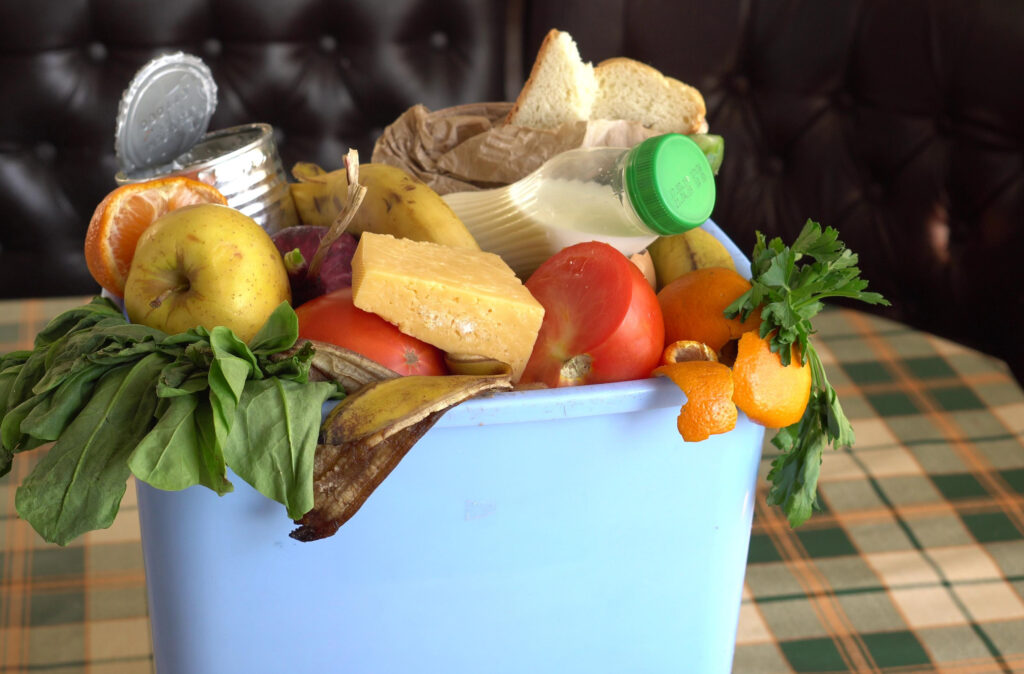
Do we realize that we waste food every day?
Most people don’t realize how much food they throw away. Every day, uneaten leftovers, spoiled produce and edible parts of fruits and vegetables that could be repurposed become food loss and waste (FLW). This critical global issue contributes directly to greenhouse gas emissions and climate change, while over 800 million people around the world go hungry.
In North America, approximately 168 million tonnes of food loss and waste are generated annually (CEC 2017). This level of inefficiency points to three fundamental reasons to reduce food loss and waste: economic, environmental and social.

In Canada1, research on household food waste shows shocking results (Box 1)
BOX 1: Food Loss and Waste in Canada
- 63% of the food Canadians throw away could have been eaten.
- For the average Canadian household, that amounts to 140 kilograms of wasted food per year—at a cost of more than $1,300 per year.
- For Canada as a whole, that amounts to almost 2.3 million tonnes of edible food wasted each year, costing Canadians in excess of $20 billion.
- All types of food are wasted, but in Canada the most prominently wasted foods by weight are:
- Vegetables: 30%
- Fruit: 15%
- Leftovers: 13%
- Bread and Bakery: 9%
This reality directly reflects the relationship people—meaning individuals, households, businesses and organizations—have with food. But it also presents a great opportunity to reconsider the role schools can play as stewards of education and values. Schools can lead by example, by reducing their own waste while educating the next generation.
Across North America, institutions, businesses and others are increasingly realizing the enormous impacts of this problem. Wasted food represents social, environmental and economic costs, but also a large opportunity. Taking action to prevent and reduce food loss and waste offers a rare “triple win” for a business, institution or other organization, as it can lower economic costs by addressing operational inefficiencies, support efforts to combat food insecurity in communities and reduce environmental impacts, including its carbon footprint.
What can be done at schools?
The problem of wasted food stands out in households as well as in food service establishments. In Canada, Mexico and the United States, wasted food at the household level exceeds the waste produced by the agrifood and hospitality sectors. Moreover, a high number of schools in the region are struggling to serve nutritious meals at reasonable prices, and school lunch waste is becoming a growing concern.
Pursuing sustainable practices has progressively been embedded in food service–related operations as well as in educational programs, and “Being Circular” or “Living Circular” is becoming a meaningful goal that moves members of society away from the business-as-usual path and its risks.
In Canada, studies are helping to better understand the unique and privileged position of schools to instill the inherent value of food in youth from the earliest age, along with their potential to develop cooperative strategies to prevent and reduce waste. School lunch programs and tools aimed at preventing and reducing waste in cafeterias, either driven by the school’s administration, or directly requested by the students themselves, are inspiring efforts that can guide further initiatives.
Measurement goes hand in hand with education
“To be successful in preventing and reducing food loss and waste, an organization or facility must first measure how much food is being lost or wasted within its boundaries. Measurement identifies the scale of the problem and the hotspots that most need to be addressed and allows for tracking progress over time. In short, what gets measured gets managed.” (Practical Guide, CEC 2019.)
There are many causes of food waste. Some examples include stocking too much food that spoils before it can be eaten; storage or packaging that fails to prevent spoilage or contamination; and disposing of food scraps in the garbage instead of collection bins for organic waste. The school cafeteria can become a “laboratory” for the adoption of more sustainable operations within the institution while fully respecting the relevant food safety regulations. Presenting a two-fold challenge, “pre-consumer” and “post-consumer” waste, the approaches to preventing and reducing food loss and waste in food service applicable to cafeterias can be upstream and downstream.
Upstream approaches:
- Training staff and working with them to measure how much wasted food is being generated in the kitchen and the cafeteria, and determining how much it is costing the school.
- Focusing on the value of the food as it moves through the supply chain and identifying processes to find opportunities for improvement: for example, rethinking purchasing models in order to maintain freshness and reduce shrink.
- Reducing overproduction of under-consumed products or shifting from production models that routinely overproduce food (e.g., buffets).
- Track success and gain support.
Downstream approaches:
- Educating students about food waste and reconnecting them with nature, agriculture and the natural resources required to produce food, such as water.
- Establishing a quality, healthy and appealing school cafeteria menu.
- Setting up “shared tables” in the cafeteria, where students can place their unwanted food or drinks (for example unopened milk cartons, packaged non-perishable snacks or whole fruits) during lunch, making these items available for other students who might need or want them.
- Setting up a system of waste bins and a clear signage in the cafeteria to minimize waste by defining bins for food donation and compost.
This is a collaborative effort that can engage kids and youth in teaming up with teachers and management. Schools can have a strong influence beyond awareness-raising, by deploying behavior-change interventions that will have a direct impact on kids once they are back home. Young people are drivers for change and are receptive to inspirational models and examples. For instance, engaging students in conducting a simple food-waste audit with the cafeteria team or designing a composting area to help kids understand the connection between their food, wildlife and habitat conservation, are fun, easy and educational options to put into place.
Over many years, all types of food have been made available year-round on grocery store shelves. Strawberries in January or oranges in August, the choices have multiplied, and access to a diversity of flavors and to exotic food is something that customers expect. In many areas, food is taken for granted due to accessibility and affordability. Conversely, in other areas, low cost has not been the main feature, for different reasons, and food insecurity has increasingly affected vulnerable communities. Fighting this and avoiding food deserts have become a bigger problem for communities and public health authorities in cities. The COVID-19 pandemic and most recent international conflicts have led to uncertainty and market volatility, resulting in rocketing prices that now determine the content of our shopping carts. Helping consumers to better understand food expiration dates, move towards balanced diets with more plant-based food and learn the possible therapeutic values of food are examples of current challenges found among consumers “often considered socially-distressed, and characterized by low average household incomes.”
As key drivers of change, schools can play a major role in addressing these challenges. Helping students develop their food literacy enables them to understand not only the challenges and impacts of wasted food, but also the opportunities it presents. Upcycling, donating and sharing food can create a sense of community and cooperation, and can help reconcile food and nature, while building a more sustainable future.
THE AUTHOR:
Antonia Andúgar Miñarro, Project Lead, Sustainable Living and Economies Unit, Commission for Environmental Cooperation
Web Resources
- Reducing Food Waste at K-12 Schools. US Department of Agriculture (USDA), 2023. <https://www.usda.gov/foodlossandwaste/schools>.
- Every Bite Counts Blog. Love Food Hate Waste Canada, FoodMesh, 2025. <https://lovefoodhatewaste.ca/blogs/22023/>.
- Taming Lunch Box Leftovers: Reducing Food Waste from Kids’ Lunches. Love Food Hate Waste Canada, FoodMesh, 2025. <https://lovefoodhatewaste.ca/blogs/taming-lunch-box-leftovers-reducing-food-waste-from-kids-lunches/>.
- Back to School, Back to Saving: 90% of Parents in Canada Say School Lunches Return Home Not Fully Eaten Each Week. Too Good To Go, 2024. <https://www.toogoodtogo.com/en-ca/press/back-to-school-back-to-saving-90-of-parents-in-canada-say-school-lunches-return-home-not-fully-eaten-each-week>.
- About Food Waste. Love Food Hate Waste Canada. FoodMesh, 2025. <https://lovefoodhatewaste.ca/about/food-waste/>.
- Chef Massimo Bottura: Tackling Food Waste is About Creating Beauty through Respect. Miranda Gran, UNEP, 2025. <https://www.unep.org/news-and-stories/story/chef-massimo-bottura-tackling-food-waste-about-creating-beauty-through>.
Tools and Resources
- Why and How to Measure Food Loss and Waste: A Practical Guide (Version 2.0). Brian Lipinski & Austin Clowes, Commission for Environmental Cooperation (CEC), 2021. <https://www.cec.org/files/documents/publications/11869-why-and-how-measure-food-loss-and-waste-practical-guide-version-20-en.pdf>.
- Food Matters Action Kit, Commission for Environmental Cooperation (CEC),2019. <https://www.cec.org/flwy/>.
Studies and Initiatives
- Too Good To Go Canada Food Waste Study: Best Before Date Confusion. Dalhousie University Agri-Food Analytics Lab, and Too Good To Go, 2025. <https://www.newswire.ca/news-releases/new-study-reveals-how-much-best-before-dates-confusion-costs-canadian-households-878914153.html>.