

I loved being a principal. So much so that I remained in the role for nineteen years, serving as a principal at the elementary, middle, and high school levels. That is not to say the work was without challenge. Like principals everywhere, I navigated some of the most difficult moments in school leadership, including leading through a global pandemic. And yet, time and again, the rewards outweighed the challenges. More importantly, each challenge shaped me into a better leader.

We did not step into school leadership to simply be good. We stepped into this profession to be great. Yet principals cannot be everything to everyone. The role is expansive, complex, and often overwhelming. In What Makes a Great Principal, we help school leaders focus their time, energy, and attention by organizing the work around five interconnected pillars that together create the conditions for meaningful learning and sustained improvement. Great principals are Visionary Leaders who anchor decisions in purpose and possibility. They are Relationship Builders who create environments where people feel safe, valued, and challenged to grow. They are Continuous Learners who keep teaching and learning at the center of the work. They are Resource Maximizers who understand how structures, time, and processes either support or sabotage improvement. And, at the heart of it all, they are Talent Cultivators.
The Talent Cultivator pillar recognizes a simple but often overlooked truth: the greatest resource in any school is the people within it. Leadership is not about control or compliance, but about creating the conditions for educators to do their best work. As Simon Sinek reminds us, “Leadership is not about being in charge. It is about taking care of those in your charge.” When principals embrace this mindset, schools become places where collective wisdom is honored, professional growth is shared, and students ultimately benefit from the best thinking of the adults who serve them.
From “Building Capacity” to Accessing Capacity
In education, we are really good at grabbing onto catchphrases and using them incessantly until teachers are begging us to put a phrase to rest. One of the most common phrases over the past several years has been “building capacity”. It shows up in professional learning plans, leadership frameworks, and school improvement goals. Sometimes it refers to instructional growth. Sometimes it refers to leadership development. Almost always, it is well intentioned.
At its core, building capacity is meant to signal learning that fosters independence. But embedded in the phrase is an assumption that capacity is something missing, something that needs to be constructed from the outside in. What if, instead, we believed the capacity is already there? What if our work as leaders shifted from building capacity to supporting teachers in accessing the capacity they already possess?
The talent is present in the educators in your school. The job of a principal is not to manufacture excellence, but to cultivate it. The most valuable commodity in any school is the collective wisdom of its educators, and the answers to our most persistent challenges are already there, waiting to be uncovered together.
Finding the Best in Others, and Helping Them Believe It
I often tell stories of my own shortcomings to share my learning and growth. I am, and always will be, a work in progress. I admire humility in others and strive to lead with a balance of confidence and openness. That said, sometimes a compliment can teach us as much as criticism.
One of the greatest compliments I ever received came from one of my quietest teachers. As I was leaving my last principalship, she posted a picture of me on Facebook and wrote: “It’s rare I put anything out there like this, but here goes. See this beautiful soul? She might not know it, but she has had one of the biggest impacts in my life of anyone I’ve ever met. She finds the best in you and somehow helps a person believe it.”
That is our job, my principal friends. One of the most important responsibilities we have is to find the best in each staff member and help them see it, trust it, and believe in themselves. Talent cultivation begins with belief: first, our belief in our teachers, and then their belief in themselves.
Cultivating Collective Talent
If principals want to label themselves as a specific “type” of leader, such as instructional, learning, or transformational leader, the most impactful title might be “collective efficacy leader”.
Rachel Eells’s 2011 meta-analysis, which synthesized results from twenty-six studies, found that collective teacher efficacy has one of the strongest known relationships to student achievement. Anyone who has experienced a team of educators who truly believe they serve students better together is not surprised by this finding. There is something powerful about educators who examine evidence, learn from one another, and share responsibility for student success.
Unfortunately, we often confuse meeting together with working collectively. Shared planning time, frequent meetings, or standing agenda items do not automatically lead to collective efficacy. In many schools, the vulnerable, trusting relationships required for true collaboration have not been fully established. Even more commonly, pedagogy and evidence of student learning are absent from team conversations.
I see this pattern repeatedly when coaching teacher teams and school leaders. The intention is there. The commitment is there. What is missing is a shared understanding of what collective efficacy actually is and how to cultivate it.
Self-Efficacy and Collective Efficacy
Self-efficacy is the belief in your own ability to effect positive change. A self-efficacious teacher facing disengaged students might say, “I’m going to try a new strategy, collect evidence, and adjust based on what I learn.” A teacher with low self-efficacy might say, “I’ve tried everything. Nothing works.”
Collective efficacy extends that belief beyond the individual. It is the deep conviction that challenges are best solved together. It is knowing that when students struggle, the collective expertise of the team can generate better solutions than any one teacher working in isolation.
When collective efficacy is present, teachers do not feel alone. They feel supported, capable, and empowered to take risks in service of student learning.
The Cost of Trying to Fix Everything
One of the most discouraging realities in schools today is the pressure to fix everything at once. Initiatives pile up. Priorities compete. As a result, very little is implemented in depth, leaving educators feeling overwhelmed and guilty. A far more effective approach is to focus on a few high-leverage efforts and commit to doing them well.
Collective efficacy strengthens any initiative by giving teachers ownership, clarity, and a team to lean on for support. Creating that environment of interdependence requires intentional leadership. Below are three foundational ways principals can cultivate collective talent in their schools.
Three Ways Principals Cultivate Collective Efficacy
1. Establish Trusting Relationships Within Teams
Collective efficacy cannot exist without trust. Trust must be developed intentionally. The chart below, from the book Less Talk, More Action, can help teams distinguish between transactional and transformational teams. Sharing this graphic with teams and helping them identify their own strengths and next steps can lead to powerful conversations.
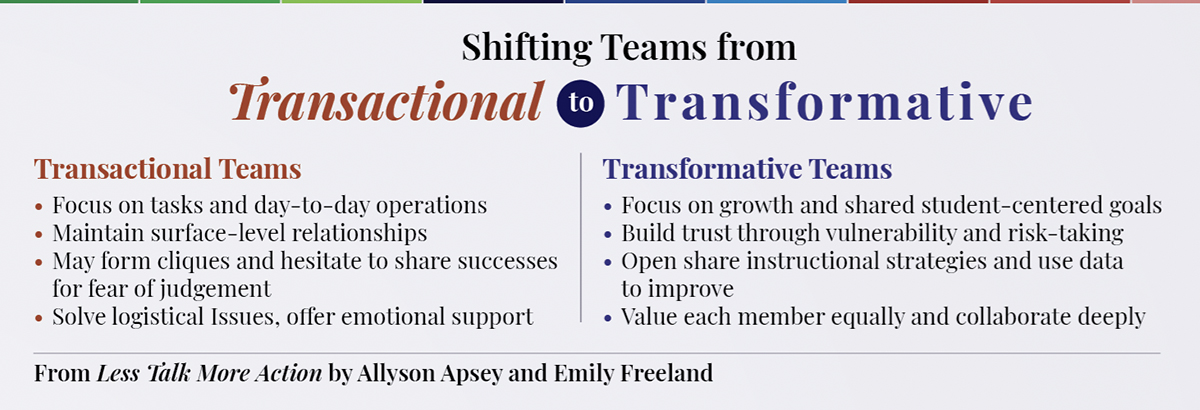
Ask them to reflect on what they need from their team to do their best collaborative work. Then support them in sharing those needs. Capture these commitments and revisit them as teams establish norms, behaviors that guide how they work together.
While some leaders pre-create norms, I have seen the greatest impact when the team develops and consistently reinforces them. When teachers feel heard and respected, trust deepens, and collaboration becomes more authentic.
2. Create a Shared Definition of Collective Efficacy
Collective efficacy must be defined before it can be strengthened. Collaborating with teachers to articulate what it looks like and sounds like in practice is essential. Clear success criteria help teams identify both strengths and next steps.
Questions that support this shared understanding include:
- What does collective efficacy look like during team meetings?
- What happens when one teacher’s students are mastering a concept while another’s are struggling?
- What systems can we create to keep instruction and evidence of learning at the center?
- How do we sustain a focus on pedagogy during busy seasons of the school year?
- How can conversations about learning, assessment, enrichment, and support remain grounded in inquiry?
When teams answer these questions together, collective efficacy moves from an abstract idea to a lived practice.
3. Protect Time and Provide Coaching
Time for collaboration must be scheduled and protected. Shared planning, early-release days, late starts, and rotating substitutes can provide opportunities for collaboration. But without prioritization, even the best schedules will fail.
Once time is secured, teams need support to use it well. Just like any new practice, effective collaboration is learned over time. A dedicated coach can model facilitation, keep the focus on evidence of student learning, and gradually release responsibility to the team. Over time, the coach becomes a guide on the side as collective efficacy becomes embedded in the school culture.
Why This Work Matters
Working alongside educators across a wide range of school communities has reinforced my belief that this type of teaming is essential to student achievement and teacher satisfaction. Teachers did not enter the profession to analyze percentages in isolation. They entered to make a meaningful difference for students.
When teachers understand the process of collective inquiry, they value the time spent together examining student work, refining instruction, and sharing strategies that work in their context. Creating a culture of collective efficacy honors their expertise, restores joy in the work, and ultimately benefits students.
ABOUT THE AUTHOR:
Allyson Apsey is an award-winning school leader, author, and international speaker who has served as a principal at every K-12 level. With over 27 years of experience in education, she is passionate about helping educators create schools where both students and staff thrive. Allyson is the author of several books and now serves as Director of Client Relations with Creative Leadership Solutions, where she partners with districts across the country to deliver coaching, professional learning, and leadership development. Known for her engaging stories, practical strategies, and contagious optimism, Allyson inspires audiences to embrace growth, build strong teams, and lead with both courage and compassion.